
Commercial Construction
Tenant Improvements in Ocala, FL
Ocala Building Contractor is a Disabled Veteran Owned Business and a licensed contractor in the State of Florida (CBC1263067), with 17 years of construction experience. Office: 217 SE 1st Ave Ste 200 – 18, Ocala, FL 34471. Call (352) 820-6068. Work in Ocala is dispatched from that office. See general contractor work in Ocala.
A tenant improvement changes a space for one occupant. The lease and the code both have a say.
Start with the exhibit, not the rendering
Tenant Work Has a Landlord
Hours, demising walls, and who owns the permit.
Disabled Veteran Owned Business, Florida License
Ocala Building Contractor is a Disabled Veteran Owned Business and a licensed contractor in the State of Florida (CBC1263067), with 17 years of construction experience. Call (352) 820-6068. For city versus county Ocala lots, use the Ocala service area page.
A tenant improvement is the work that turns a leased bay into one occupant’s space. The pretty rendering is not the contract. The exhibit, the work letter, or the criteria manual is. Those pages say what the landlord delivers and what the tenant builds. A commercial construction price that never opens them will argue with the landlord at the end, when the argument is expensive.
Read the exhibit against the bay, not against the marketing plan. If the lease says a restroom, a storefront, and a rooftop unit are delivered, and the walk shows a bare slab and a plywood front, the difference is a written gap. We do not price the rendering and call the gap a change order later. Either the landlord still owes that delivery, or the tenant’s scope grows, and both sides should see which one it is.
Base building work and tenant work are different checks
Base building is the shell the landlord keeps: structure, roof, common corridors, shared restrooms, the main electrical service, and often the fire sprinkler up to a shell standard. Tenant work is what makes one bay usable for one use: partitions, ceilings, finishes, and the mechanical and electrical runs that serve only that suite. The labels change from lease to lease. We use the lease in front of us, not a generic chart from another center.
Cutting a rated corridor wall, adding a rooftop curb, or upsizing the building service is usually not a tenant finish, even if the tenant’s plan is what created the need. A shell build-out can include both kinds of work, but the pay application and the approval path should not mash them together. The landlord’s lender and the tenant’s lender will not mash them together either.
Who supplies the equipment, the finishes, and the keys
Someone has to buy the long-lead items, and someone has to say whose purchase order that is. HVAC equipment, switchgear, storefront, and kitchen hoods do not appear because a schedule hopes they will. If the tenant supplies equipment, we need submittals that match the permit set, not a catalog page taped to a wall. If the landlord supplies it, we need a date that is real, because our crew cannot hang duct on a unit that is still a line item in someone else’s bid.
Finishes work the same way. The lease may require a building-standard carpet in the corridor and leave the sales floor to the tenant. Mixing those up means tearing out work that was fine under the code and wrong under the lease. Keys, alarm codes, and roof access are supplies too. A crew locked out of the electrical room at 7 a.m. is not a labor problem. It is a missing agreement about who opens the building.
After-hours work in a building that is still open
Many suites are built while the rest of the center is selling, seeing patients, or sitting in offices. The lease or the property manager then pushes noisy, dusty, or odorous work to nights or Sundays. That is a staffing and a cost fact. It is not a mood and it is not a promise that the whole job happens after dark. We separate work that can happen while neighbors are open from work that cannot, and we write the noisy list down.
Dust that migrates into the next bay is a claim, not a story. We plan protection at the demising wall, a path for materials that does not cross someone else’s sales floor, and negative air when the work produces dust. Hot work, roof access, and use of the only freight elevator get scheduled with the manager. If the lease is silent, we still ask before we assume the corridor is ours at dawn.
Neighbors, corridors, and the loading path
The building was there first. Deliveries may have to come through a shared dock, a single door, or a parking lot the landlord does not want blocked at noon. Dumpsters have assigned locations. Protection of common floors is part of the job, not a favor. We would rather walk that path with the property manager before the first truck than explain a cracked tile in a corridor we were not supposed to use.
Insurance shows up here as well. Leases often require a certificate that names the landlord, and sometimes the property manager, before work starts. That language is in the lease, not in a rule we invent for every center in Marion County. Send the clause. The certificate we issue states the coverage we actually carry. Limits are not printed on this page. The place to read how the company handles that request is licenses and insurance.
Closeout has to satisfy the lease and the inspector
The building department wants the inspections for the parcel. The landlord wants the punch list in the lease, as-built notes, warranties, and keys. Those are not the same packet. A passed final inspection does not waive a storefront detail the criteria manual required. A landlord walk that feels friendly does not replace a failed inspection. We keep the two lists separate so nobody confuses a handshake for a certificate.
- Put the exhibit and the drawings in one scope, and mark every mismatch.
- Label landlord work and tenant work the way this lease uses those words.
- Name who buys equipment, who approves submittals, and who has roof and electrical-room access.
- List work that must happen after hours, and work that can happen while neighbors are open.
- Set a material path, a dumpster spot, and floor protection before the first delivery.
- Keep the permit closeout and the lease closeout as two lists.
| Item people argue about | Often base building | Often tenant work |
|---|---|---|
| Demising walls and the shell roof | Delivered by the landlord, if the lease says so | Patched or cut only with a designed opening |
| Common restrooms and the corridor | Shared, and not ours to remodel on a whim | The path from the suite to those rooms, kept clear |
| Electrical service into the building | Utility and main gear, sometimes landlord | Panel, circuits, and devices that serve only this bay |
| Rooftop unit serving the bay | Ownership follows the lease, not a guess | Distribution inside the suite for the new rooms |
| Storefront and sign band | Criteria and the existing opening | Interior finishes and the sign package the tenant owns |
The permit still follows the parcel. Inside Ocala, Belleview, or Dunnellon, that city reviews the plans. Unincorporated Marion County goes through Marion County Building Safety. An office address on a letterhead does not decide it. Where we work most often is covered on the Ocala page, and the way to start a walk of a real bay is to contact the office. What moves a build-out number, without a published allowance, is in commercial build-out cost. The permit questions are in commercial construction permits.
When the lease and the code disagree
They will, sometimes. The lease may allow a room the code will not, or the code may require a restroom arrangement the landlord does not want to pay for. We do not pick a winner in the field. We write the conflict and stop the part of the work it touches until the landlord, the tenant, and the designer resolve it. Building the cheaper version and hoping the inspector is in a good mood is how suites get opened late.
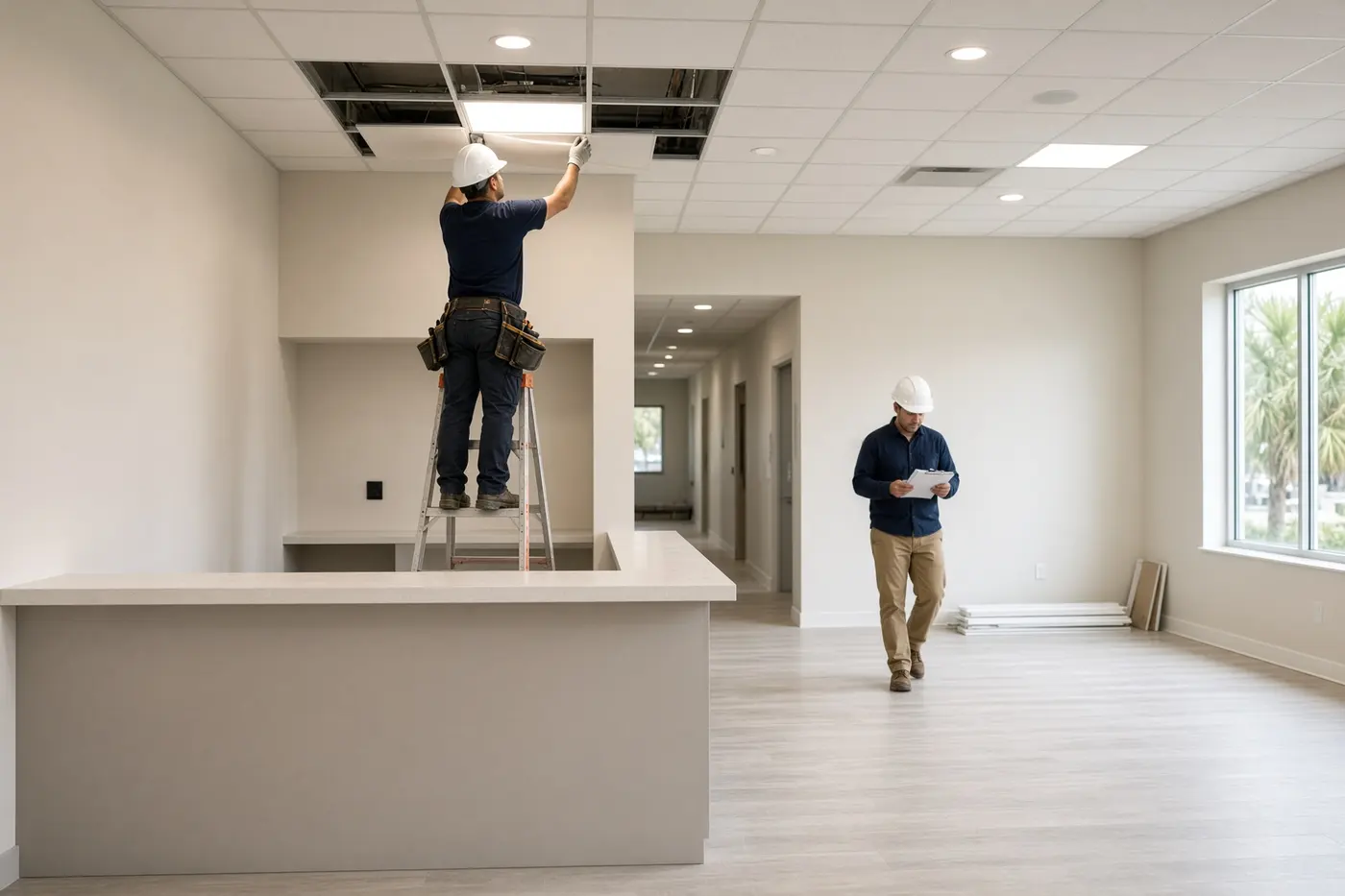
Put the exhibit next to the bay
Ocala Building Contractor is a disabled veteran-owned company with 17 years of construction in Ocala and Marion County. Call (352) 820-6068 with the lease exhibit and a time to walk the suite. We will separate landlord work from tenant work before after-hours labor and long-lead gear get assumed.
Also in Commercial Construction
These pages are the rest of this cluster. The hub is Commercial Construction.