
Projects
Commercial Projects
Commercial projects are build-outs and tenant improvements. This page does not invent a tenant or a contract amount.
Commercial projects are types, not tenants
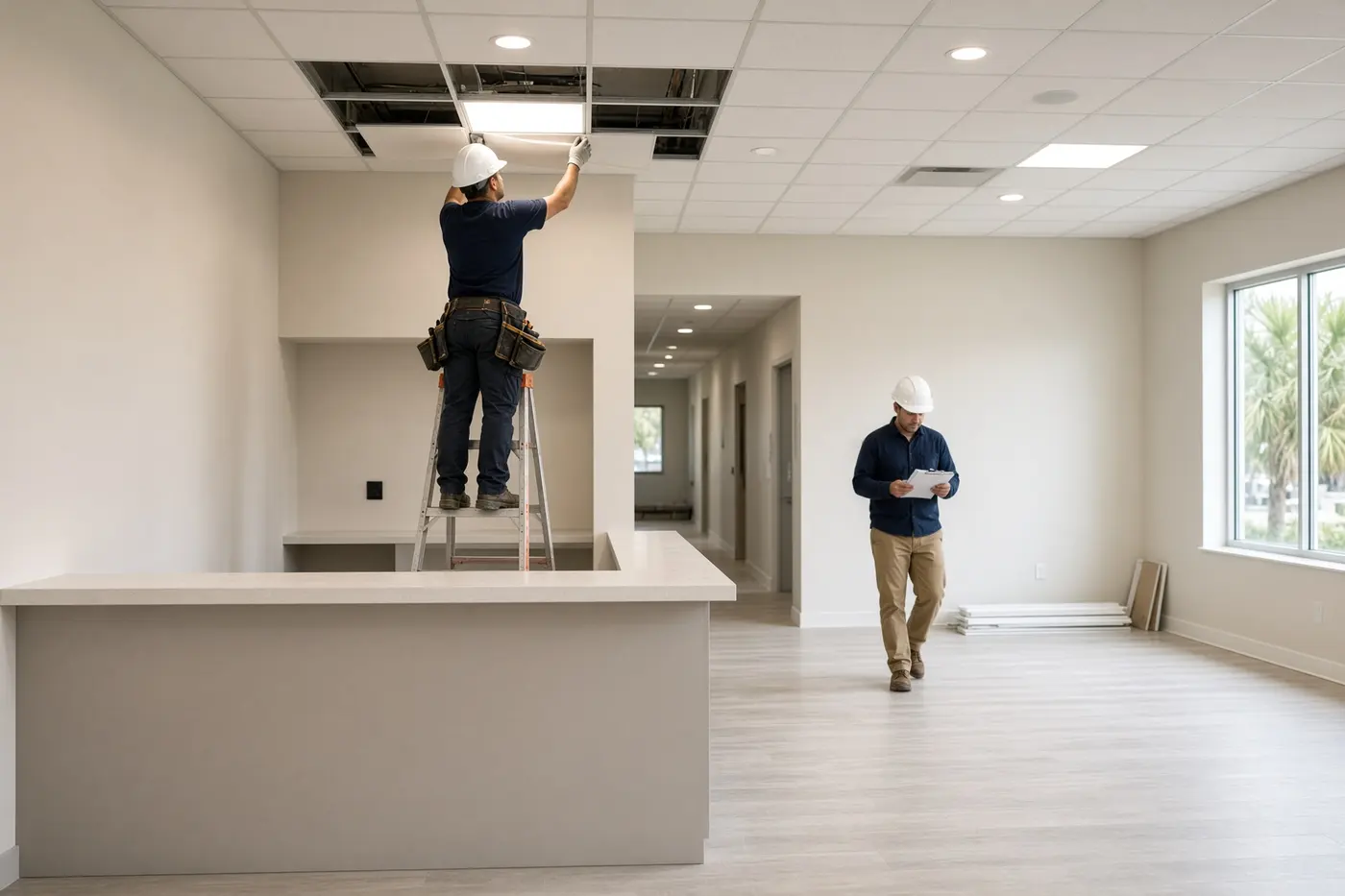
A commercial project page is where a contractor is tempted to invent a tenant. A name on a door looks like proof. It is also the fastest way to claim a business that never signed a contract. This page does not do that. Offices, retail shops, restaurants, and medical suites are discussed as project types. No landlord is named, no suite number is given, and no opening date is implied. The photograph of a reception area elsewhere on the site is representative. It is not a claim that this company built that desk or that ceiling.
A real commercial record, when one exists, would still be dull on purpose. It would identify the building, say whether the work was a tenant improvement inside an existing shell or work on the shell itself, and describe the scope: partitions, ceiling, lighting, restrooms, storefront, or the particular rooms the occupant needed. It would name the year and the building department. It would say who was allowed to be mentioned. Landlord permission and tenant permission are not the same signature. Publishing either name without that permission is how a portfolio becomes a problem for someone who is not the contractor.
The lease is not the permit. A landlord can require finishes, hours, and insurance that the building code never mentions. The building department can require egress, accessibility, and rated walls that the lease never mentions. A record that quotes only the lease misses the code. A record that quotes only the permit misses the deal the occupant actually has to live with. Both documents belong in the job file. Neither is invented here to make a case study sound complete.
How the four types differ
An office build-out is mostly rooms, paths, and services. Private offices or an open area, a reception point, a break room, power and data, lighting, and a ceiling that can be opened again later. The base building may already have the restrooms and the air handler. The tenant scope may stop at the inside of the demising walls. A record would say where that line was. Without that line, a photo of a finished lobby could be the landlord’s shell, the tenant’s furniture, or the contractor’s work, and those are three different facts.
Retail is a sales floor, a stock area, and a front that customers can enter. The entry has to work for people, including people using wheelchairs, and the path from the sidewalk to the sales area is part of the project when the scope says it is. Fixtures the retailer owns are often not the contractor’s work. A record would separate built walls from gondolas that arrive on a truck. This page will not borrow a chain’s name to make a stock photo feel local.
A restaurant is a different building problem from an office even when it sits in the same strip. Floors get wet. Exhaust for cooking equipment is a designed path, not a residential hood. Grease and floor drainage show up in the scope when the menu needs them. Food-service licensing is a separate path from the building permit, and this page is not that application. It only marks the type so nobody treats a dining room as a conference room with different chairs. A medical suite is different again: exam rooms, sinks, privacy, and accessibility. Special systems, if a real suite needed them, would be named in that job’s scope. They are not assumed because the word medical appeared.
What you can learn before any name is attached
You can learn to ask who owns the building, who occupies it, and who is hiring the contractor. Those can be three parties. You can learn to ask what is already in the shell: restrooms, stairs, fire sprinklers, electrical capacity, and the hours the building will allow noise. You can learn that a beautiful waiting room in a photograph does not disclose any of that. The commercial construction pages describe the services. This category does not repeat them as if a tenant had been served. The project index explains the same rule for houses and roofs.
You can also learn which office would review the plans. Commercial work follows the parcel, just as a house does. The building permits guide is the place to sort city limits from unincorporated land. After that, if you already control a space, the conversation is about that space. Use contact when you are ready to name the address. Do not send a photo of someone else’s lobby and ask for a match.
- Building identified, and only with permission to say so
- Tenant improvement or base-building work, stated as one or the other
- Scope line between landlord shell and occupant fit-out
- Year and building department
- Occupancy type in ordinary words: office, retail, restaurant, or medical suite
- No borrowed brand names and no invented opening day
| Type | The question that defines the job | What this page will not add |
|---|---|---|
| Office | Where the tenant scope stops inside the shell | A company name on the reception wall |
| Retail | What is built versus what is store fixture | A chain’s logo to localize a photo |
| Restaurant | Cooking exhaust, wet floors, and a licensing path separate from the permit | A menu, a chef, or a claimed opening |
| Medical suite | Rooms, sinks, privacy, and any special system actually in the scope | A clinic name or a patient story |
What the representative interior is for
The interior photo on commercial pages shows a reception area with the ceiling still open in places. That is a teaching picture of a build-out underway. It is not a documented lobby. You can use it to notice that commercial work is often finished while other trades are still above the grid. You cannot use it to claim a client, a square footage, or a construction cost. Those numbers are not hiding in the image. They were never collected for this page.
Bring the space, not a made-up tenant story
No tenant is named on this page because none has been documented here. If you already control a space in Ocala or Marion County, an office, a shop, a restaurant shell, or a medical suite, Ocala Building Contractor can talk through the build-out. The company is disabled veteran-owned, with 17 years of construction experience. Call (352) 820-6068. Read the commercial construction pages first if you are still deciding what the work is.
Also in Projects
These pages are the rest of this cluster. The hub is Projects.